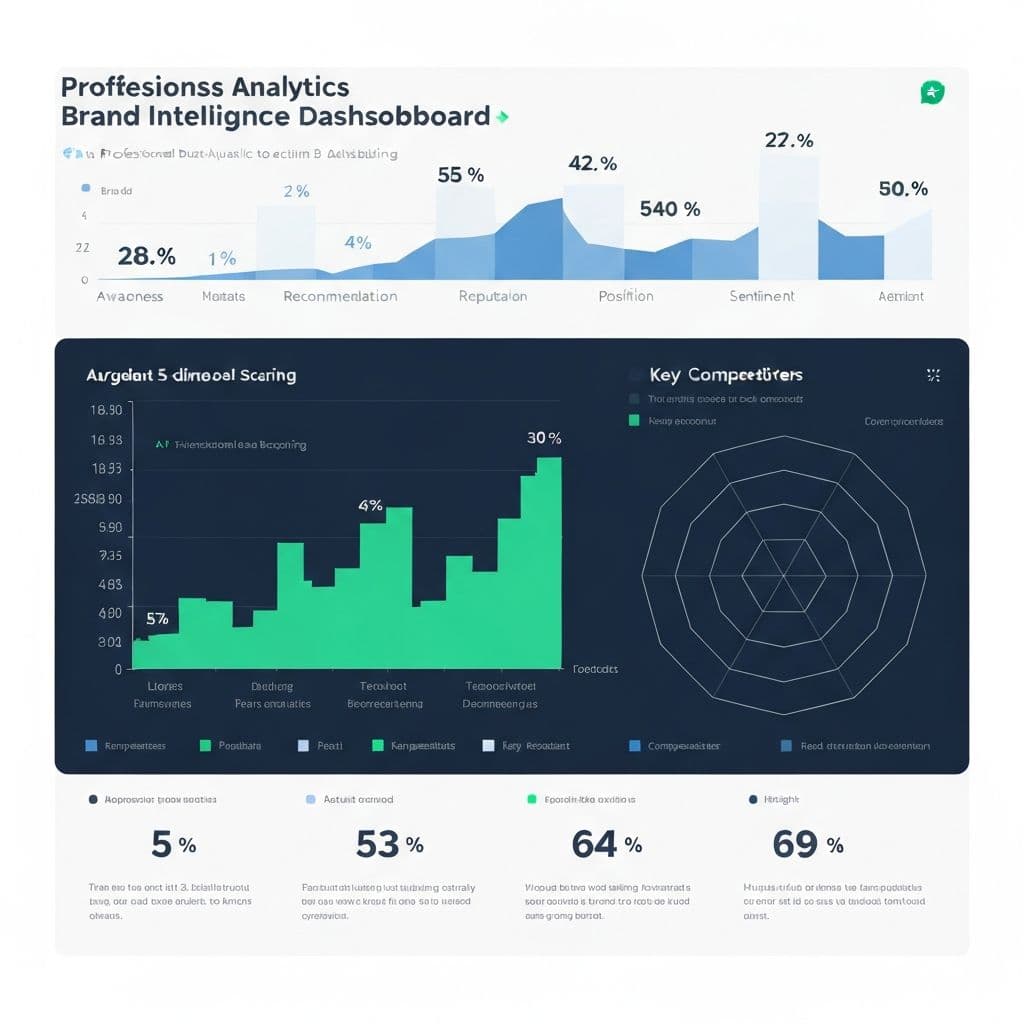
Every AI monitoring tool will tell you whether your brand was mentioned. That's the easy part. The hard part — the part that actually drives business decisions — is answering how well your brand was represented, whether that representation is improving or degrading, and how it compares to every competitor in your space across every major AI platform.
That's what the Brand Intelligence Score solves. It's Digraph's composite metric for AI visibility health: a single number between 0 and 100, computed across five independent dimensions, verified through our multi-layer data retrieval pipeline, and updated continuously across all eight monitored platforms.
Why Five Dimensions Instead of One
A single "visibility score" is seductively simple. But it collapses too much information into too little signal.
Consider two brands that are both mentioned 70% of the time across AI queries. If Brand A is consistently recommended first with positive framing and accurate information, while Brand B is mentioned last as an afterthought with outdated pricing and negative caveats — they have identical mention rates but radically different brand health.
A one-dimensional score can't capture this. A five-dimensional score can.
The Five Dimensions
1. Awareness — The Foundation
What it measures: The percentage of brand-relevant queries where your brand appears in the response, averaged across all monitored platforms weighted by platform market share.
Awareness is the floor. If your brand isn't being mentioned, nothing else matters. A brand with 20% awareness across 50 relevant queries is invisible for 80% of AI-mediated research in its category.
2. Recommendation — Beyond Mere Mention
What it measures: When your brand is mentioned, is the AI system actively recommending it — or just acknowledging its existence?
This dimension separates "Digraph is a platform in this space" from "Digraph is a strong choice for teams that need multi-platform monitoring." The first is awareness. The second is a recommendation.
3. Reputation — Qualitative Framing Analysis
What it measures: How is your brand described? Are strengths mentioned before weaknesses? Are you characterized with authority-signaling language or diminishing language?
Two brands can have identical Awareness and Recommendation scores with completely different Reputation scores. If AI systems consistently describe your competitor as "enterprise-grade" and you as "suitable for small teams," that framing shapes every reader's perception — even if both brands are technically recommended.
4. Position — The Serial Position Effect
What it measures: Where in the response does your brand appear? First mentioned? Third? Last?
This dimension quantifies the serial position effect — a well-documented cognitive bias where items presented first in a sequence are remembered better and perceived as more important than items in the middle or end. Position is the dimension that most directly correlates with competitive displacement.
5. Sentiment — Net Emotional Tone
What it measures: The net positive or negative emotional tone across all mentions, using analysis specifically calibrated for AI-generated text.
Sentiment is the fastest-moving dimension. A single negative event can shift Sentiment dramatically before any other dimension changes. This makes Sentiment the most valuable dimension for early warning alerting: a sudden drop is a signal that requires immediate investigation.
The Composite Score
The five dimensions combine into the Brand Intelligence Score using carefully calibrated weights:
| Dimension | Weight | Rationale |
|---|---|---|
| Awareness | 25% | Foundational — without it, nothing else matters |
| Recommendation | 25% | Directly determines consideration |
| Reputation | 20% | Shapes perception quality |
| Position | 15% | Influences competitive selection |
| Sentiment | 15% | Early warning and trend indicator |
Awareness and Recommendation carry the highest weights because they most directly determine whether a potential customer encounters and considers your brand. Reputation is weighted as the qualitative modifier. Position and Sentiment serve as competitive and temporal indicators.
Competitive Benchmarking: Your Score in Context
An isolated score is useful but incomplete. A score of 65 in a category where the leader scores 90 tells a different story than a 65 where the leader scores 68.
Digraph computes the Brand Intelligence Score for every tracked competitor using the same five-dimensional model. The dashboard surfaces per-dimension competitive gaps — which specific dimensions competitors outperform you on — and per-platform competitive positioning — which platforms represent your biggest vulnerability.
Historical Trending: The Intelligence Layer
A score is a snapshot. A trend is intelligence.
Digraph tracks Brand Intelligence Scores over time at every level of granularity: composite, per-dimension, per-platform, and per-query. This enables improvement tracking, platform update detection, competitive response detection, and seasonal analysis.
Digraph's Brand Intelligence Score tracks your AI visibility across five dimensions, eight platforms, and unlimited competitors — with verified data and historical trending. See your score.